
Great Stories. Eternal Truths.
Part 14, The Christmas Story
Watch Sermon
Let the wonder of Christmas return. Let the weight of Christmas settle into your soul. Let the familiarity fall away just enough for awe and glory to rise again.
Scripture Reference
Luke 2:1
Full Transcript
Well, as we gather here on the Lord’s Day in the Lord’s house to sing the Lord’s praises on the Sunday before Christmas, I was thinking, what would be a great sermon to preach today? And I thought, what about tithing? I thought against that.
No—actually, this morning we are turning the page on our series that we have been in, the Great Story series. We’ve been in the Old Testament, and the place that you start in the New Testament is the Christmas story. And so, if you will—if you’re able—if you’ll be finding in your copy of God’s Word, Luke’s Gospel, chapter 2.
And when you get there, if you’re able, if you will stand with me as we honor God in the reading of His Word. I’m going to be reading from my Christmas-story-and-funeral Bible this morning. The Christmas story just sounds best in the old, traditional King James.
Luke’s Gospel, chapter 2, verse 1. And now hear the Word of the Lord.
And it came to pass in those days that there went out a decree from Caesar Augustus that all the world should be taxed. And this taxing was first made when Sirenius was governor of Syria. And all went to be taxed, every one into his own city. And Joseph also went up from Galilee, out of the city of Nazareth, unto Judea, unto the city of David, which is called Bethlehem, because he was of the house and lineage of David, to be taxed with Mary, his espoused wife, being great with child. And so it was that, while they were there, the days were accomplished that she should be delivered.
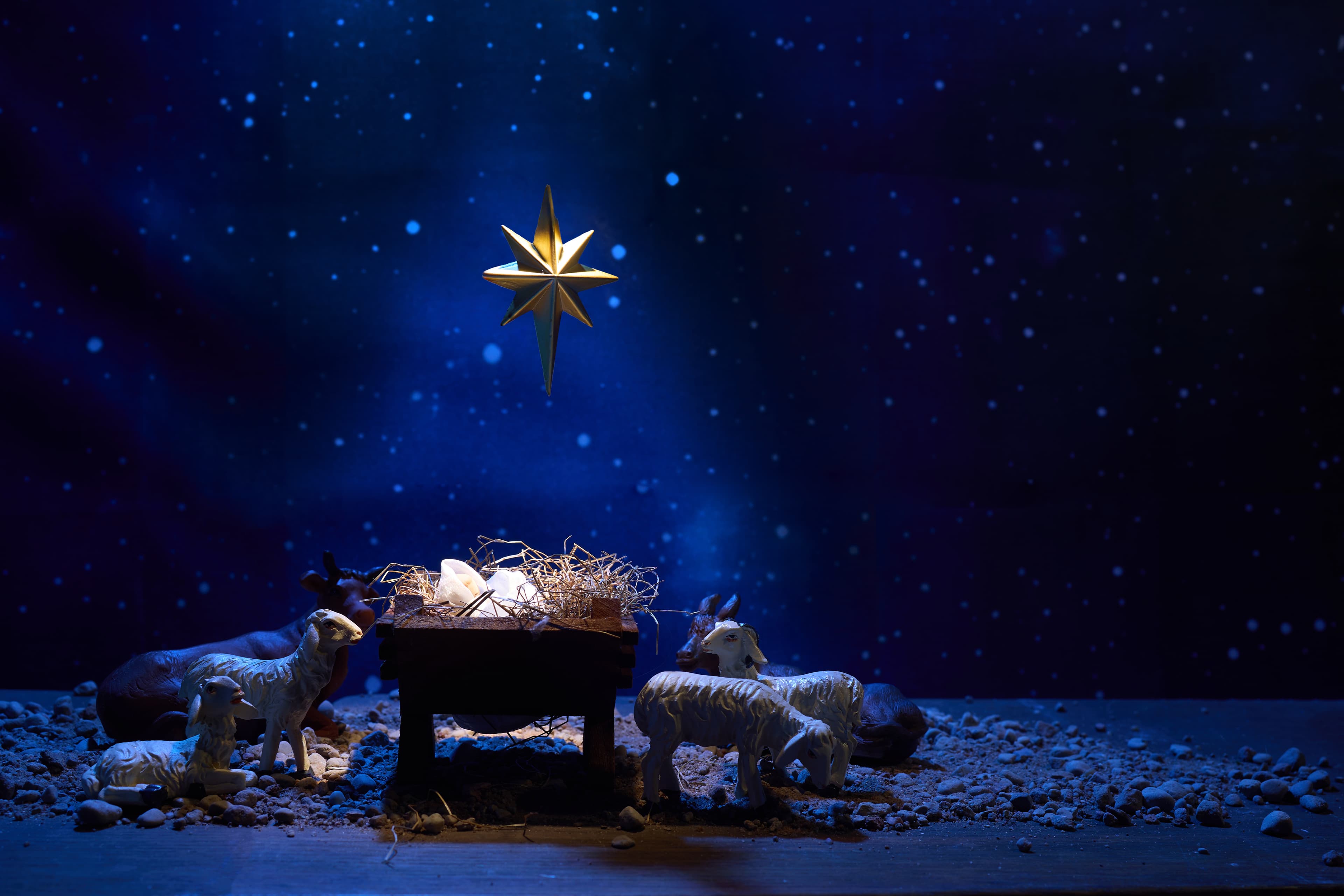
And she brought forth her firstborn Son, and wrapped Him in swaddling clothes, and laid Him in a manger, because there was no room for them in the inn. And there were in the same country shepherds abiding in the fields, keeping watch over their flock by night. And lo, the angel of the Lord came upon them, and the glory of the Lord shone round about them, and they were sore afraid.
And the angel said unto them, “Fear not: for behold, I bring you good tidings of great joy, which shall be to all people. For unto you is born this day in the city of David a Savior, which is Christ the Lord.
And this shall be a sign unto you: Ye shall find the babe wrapped in swaddling clothes, lying in a manger.” And suddenly there was with the angel a multitude of the heavenly host praising God, and saying, “Glory to God in the highest, and on earth peace, good will toward men.”
And it came to pass, as the angels were gone away from them into heaven, the shepherds said one to another, “Let us now go even unto Bethlehem, and see this thing which has come to pass, which the Lord hath made known unto us.” And they came with haste, and found Mary, and Joseph, and the babe lying in a manger.
And when they had seen it, they made known abroad the saying which was told them concerning this child. And all they that heard it wondered at those things which were told them by the shepherds. But Mary kept all these things and pondered them in her heart. And the shepherds returned, glorifying and praising God for all the things that they had heard and seen, as it was told unto them.
May the Lord add His blessing to the reading, the preaching, and now your hearing to understand His holy Word. May our Lord and Savior Jesus Christ forever be praised. And all of God’s people say, “Amen.” You may be seated.
For the last several months, we’ve been walking through some of the greatest stories of the Old Testament—stories that shaped a nation, the nation of Israel; stories that revealed God’s character; stories that pointed us forward to something greater.
We’ve seen courage tested. We’ve seen faith refined. We’ve seen obedience demanded. And we’ve seen God’s faithfulness proven again and again.
Today, we make an important turn. We move from the great Old Testament stories that foreshadowed and pointed forward to the greatest story—the greatest story ever told—the stories from the life of Christ in the Gospels.
From here, this series will carry us all the way through Easter and the Ascension. It’ll carry us from a manger to a cross. It’ll carry us from an empty tomb to a risen and reigning Savior.
When most people think of the Christmas story, they think of what I’ve just read. They think of the Gospels. They think of Luke—angels singing, shepherds watching their flocks, a baby laid in a manger. And that’s the right thing. Luke gives us the most familiar and detailed telling of the Christmas story.
But the story of Jesus’s birth doesn’t belong to Luke alone. Actually, Matthew’s Gospel tells us about Joseph and his obedience—how he heard from the angel and obeyed what the angel told him. It tells us the story in Matthew of the wise men, the magi from the east, and the fulfillment of ancient promises.
But then there’s also John. Now, Mark does not have the Christmas story in any meaningful way, but John takes us even farther back—deeper back—back before Bethlehem, before Mary, before even creation itself—declaring John’s Christmas story by saying that the Word was with God, and the Word was God.
This morning, we’re going to harmonize these Gospel accounts—bringing them together, getting all the rich details, the symphony of Matthew, Luke, and John being brought together. And I want you to do something. Whether you’ve heard this story a hundred times or a thousand times, or whether you’re hearing it for the first time, I want you to listen as though this is breaking news. I want you to listen as though you’ve never heard this story before.
Let the wonder of Christmas return. Let the weight of Christmas settle into your soul. Let the familiarity fall away just enough for awe and glory to rise again. Because this is not just a Christmas story. This is the moment when eternity stepped into time. It’s the story of when God kept His promises made thousands of years before, and when the greatest story ever told began to unfold.
And so we start where we have started the last thirteen weeks in this series—with retelling the story.
Before there was a manger, before there was a mother named Mary, before there was a star in the sky, there was the Word. In the beginning, before time, before creation, before light had even pierced the darkness, the Word already was. And the Word was with God, and the Word was God. And through Him, everything that exists had come into being. And in Him was life—the kind of life that shines light into the darkness.
And then, in a moment that no one expected, the Word stepped into the world. The Word stepped into the world that He had made—not with thunder, not with armies, but with a whisper. In a small town called Nazareth, an angel named Gabriel appeared to a young woman named Mary. She wasn’t powerful or popular. She wasn’t wealthy. She wasn’t famous. But she was faithful.
The angel said, “Don’t be afraid. You have found favor with God. You will conceive and give birth to a son, and you will name Him Jesus. He will be great. He will be called the Son of the Most High.”
Mary was confused—and honest. There’s an important lesson there. When you’re confused about what God is saying, be honest with God. He already knows you’re confused. Amen.
Mary was confused, but honest. “How can this be?” she said. And the angel answered, “The Holy Spirit will come upon you, and the child will be holy—the Son of God.”
Mary, though she did not understand everything, trusted the One who did understand everything. She said, “Be it unto me, even as you have said.” She said, “I am the Lord’s servant. May it be done exactly what you’ve said.”
At that same time, Joseph—the man promised in marriage to Mary—was wrestling with his own fear and confusion. When he learned Mary was with child, and that it wasn’t his, he planned to quietly step away.
God spoke to him in a dream: “Joseph, son of David, don’t be afraid. What is conceived in her is from the Holy Spirit. She will give birth to a son, and you will name Him Jesus, because He will save His people from their sins.”
Not long after, a decree went out from Caesar Augustus—the most powerful man on earth at that time—that everyone must be registered in a census to be taxed. And because Joseph was from the line of David, he had to travel to the city of David, to Bethlehem.
Bethlehem was crowded. It was busy. It was noisy. It was bustling. And when the time came for the child to be born, there was no palace—not even a guest room—no cradle fit for a king. So Mary gave birth to her firstborn son. She wrapped Him in cloth—swaddling clothes—and laid Him in a manger, a feeding trough for animals.
The Creator of the entire universe had entered into His creation, and there was no room for Him.
But heaven noticed. Outside the town, shepherds were watching their flocks in the dark of the night. These were men no one else paid any attention to. These were men considered unimportant—the outcasts of society. And suddenly, the sky lit up with the glory of the Lord. An angel said, “Do not be afraid. I bring you good news of great joy for all people. Today, in the city of David, a Savior has been born to you. He is Christ the Lord.”
And then heaven broke open.
A multitude of angels filled the sky. The sky was filled with God’s glory, praising God and saying, “Glory to God in the highest, and peace on earth, goodwill to men.”
The shepherds ran. They found the child. They told everyone what they had seen. And they went back changed—changed men—because they had met Jesus.
Sometime later, far away in another land, wise men studied the sky, and they saw a star—something new, something royal, something calling out to them. And they followed that star, searching for a king. And when they found the child, they fell down and worshiped Him. They brought gifts fit for royalty: gold, frankincense, and myrrh.
Think of this: kings searched for Him. Scholars followed Him. Shepherds rejoiced over Him. And John tells us what all of this truly means: “And the Word became flesh and dwelt among us.” Not distant. Not untouchable. Not silent. No—full of grace, full of truth.
The light had come into the darkness. God had stepped into our story so that one day He could rescue us from our story. And that baby in the manger—He wasn’t just born to live. He was, as we sang earlier, born to save. Christ was born to save.
What a story—the greatest story ever told. And we do need to retell the story. And we need to not only retell the story every year, but we also need to, number two, remember the truths.
It is a great story, and that’s the reason it’s been made into so many Hollywood movies. But it’s not just a story—it’s meant to disciple us. Amen.
So we remember truth number one. I want you to process this for a moment: God’s plans are bigger than our understanding, but God’s plans are never smaller than His love.
Mary was given a promise that she could not fully explain. Mary was given a calling that she could not fully control. She did not receive a detailed road map. She received a word from God, and that was enough. “Be it unto me according to Your word.”
Folks, God did not minimize the cost to Mary. No—He said this is going to be costly. He didn’t minimize the cost; He maximized and magnified His grace to meet the need. Amen. And His plan stretched far beyond Mary’s comprehension, yet Mary never drifted beyond His care.
I want you to remember this: when God calls you into something you do not fully understand, it’s not because He’s careless—it’s because He’s loving.
His purpose may be vast and mysterious. And listen—I can testify—it can even be overwhelming. But God’s plans and purposes are always anchored in His goodness and His love.
When we truly believe and truly embrace that God loves us, then we can follow His plans even when we don’t understand them.
Truth number two: God often works in ordinary places with ordinary people. Amen.
I’m so glad that He does, because I don’t know if you know this or not, but Waldo, Mississippi would probably be considered pretty ordinary. And I don’t know if you know this or not, but the Reverend Jay Curtis Pace would probably be considered pretty ordinary.
It’s always been that way—always. All throughout the Bible. Nazareth was unimpressive. Bethlehem was overcrowded. Shepherds were unnoticed. And yet, this is where God chose to step into human history. No palace. No parade. No earthly spotlight. No trumpets. It was just God stepping in and wrapping eternity in obscurity that way.
And wrapping His glory—the Word became flesh, wrapping His glory with humility. Remember: never underestimate what God may be doing in the ordinary rhythms of your life. God does some of His greatest work in places the world ignores and through people the world overlooks.
We’re still talking about Lottie Moon over a hundred years later, and her obedient answer to the call in China. God is still using people—ordinary people—today. Amen.
Truth number three—we’ve got to move quickly. Obedience often comes before clarity. Joseph obeyed without all the answers. Mary surrendered to God’s will with no guarantees. The shepherds went without knowing what they would find.
This is a truth we’ve seen again and again in the Old Testament stories we were looking at. We’ve studied Abram leaving home, Noah building the ark, Joshua stepping into the river, Gideon trusting a reduced army. Folks, God rarely gives full clarity before we give full obedience.
God is not going to show you the next step if you haven’t taken the first step. Folks—faith is not waiting until everything makes sense. Faith is stepping forward because God has spoken. Obedience then often becomes the doorway through which understanding eventually enters. I can give you personal testimonies from my life that I didn’t understand what God was doing until I said yes to what God was doing. Amen.
Truth number four: the cradle points forward to the cross. Jesus was not merely born to be admired, but to redeem. The manger foreshadows the cross. The swaddling clothes anticipate the burial linens. From the very beginning, this child was born on a mission.
Christmas is not an isolated miracle. It is the opening chapter of the Gospel—the good news. You cannot separate Bethlehem from Calvary. You cannot separate the birth of Christ from the death, burial, and resurrection of Christ.
Truth number five: the birth of Jesus demands a response. No one encounters this story with neutrality. Some worship. Some obey. Some fear. Some ignore. Some resist. Herod—King Herod—was troubled. The shepherds rejoiced. The wise men bowed. But every heart that hears the Christmas story must decide what to do with Jesus.
Jesus is never background scenery. He is not simply a tradition. He’s not simply a symbol. He’s not a seasonal figure that we take out of the closet every December. His coming demands a response—then and now.
So this is how we, number three, respond with faith. The Christmas story is not meant to be admired from a distance. It does not invite us just to be spectators. It calls us to be responders.
I wonder if you’ve ever thought about this before, Miss Tanya. The shepherds were first responders. They were the first responders—literally. Amen.
From the very beginning, everyone who encountered this newborn King had to decide what they would do with Him. Herod was threatened by Him. The religious leaders were informed but unmoved by Him. The shepherds ran to Him. The wise men fell down in worship before Him. And still today, the birth of Jesus presses the same question upon every heart, every age, every person—whether you’re two or one hundred and two.
What will you do with Jesus?
As we stand just days away from Christmas morning, hear this clearly: Jesus was not born so we could rush past Him in busyness and noise and tradition. This week, respond by slowing down. Make room—not just in your schedule, but in your heart.
Like Mary, treasure these things and ponder them in your heart. Like the shepherds, go and see what the Lord has done. Like the wise men, bring your worship—not leftovers, not what’s convenient, but in reverence, the best that you’ve got—before you celebrate the gifts under the tree. Bow before the gift on the tree.
The call of Christ does not end when the decorations come down. Jesus’s birth declares that God has stepped into our world. God has stepped into our world—and that means He has rightful claim over every part of our lives.
Respond by yielding to Him. Let His truth shape your decisions. Let His grace govern your relationships. Let His lordship define your priorities.
Jesus did not come, folks, to be added to our lives. Jesus didn’t come to be added to your life—He came to rule it. As He Himself said, “Follow Me. Abide in Me. Seek ye first the kingdom of God.”
The birth of Jesus calls us not just to believe about Him, but to belong to Him. And for some here today, the most important response is the first one.
Jesus was born so that you could be born again. I’m going to say it again: Jesus was born so that you could be saved. The Word became flesh so that sinners could become sons and daughters of God. John, in John 1, again says, “To all who did receive Him, He gave them the right to be children of God—to those who believe in His name.”
If you’ve never trusted Christ, then today is the day. Turn from sin. Believe in the Savior who was born to die and rose again. Confess Him openly. Follow Him in believer’s baptism as a public declaration that your life belongs to Jesus.
The manger points to the cross. The cradle leads to the empty tomb. And the Christ who came once will come again.
The birth of Jesus demands a response.
What will you do with Jesus today?