
Great Stories. Eternal Truths.
Part 19, Water into Wine
Watch Sermon
Jesus performed His first public miracle not in a temple or in the middle of a crisis, but at a wedding celebration where an ordinary problem was about to become a family’s lasting embarrassment. In John 2, empty jars, simple obedience, and a quiet request become the setting for something extraordinary. The wedding at Cana reveals a Savior who cares about the everyday details of our lives, invites us to trust Him even when His instructions don’t make sense, and has the power to transform completely. What begins with water in a stone jar becomes a glimpse of what Jesus can do with a life surrendered to Him—and a reminder that with Christ, the best is yet to come.
Scripture Reference
John 2:1–12
Full Transcript
And now hear the word of the Lord.
On the third day, a wedding took place in Canaa of Galilee. Jesus’s mother was there, and Jesus and his disciples were invited to the wedding as well.
When the wine ran out, Jesus’s mother told him, “They don’t have any wine.”
“What does that have to do with you? What does that have to do with you and me, woman?” Jesus asked. “My hour has not yet come.”
“Do whatever he tells you,” his mother told the servants.
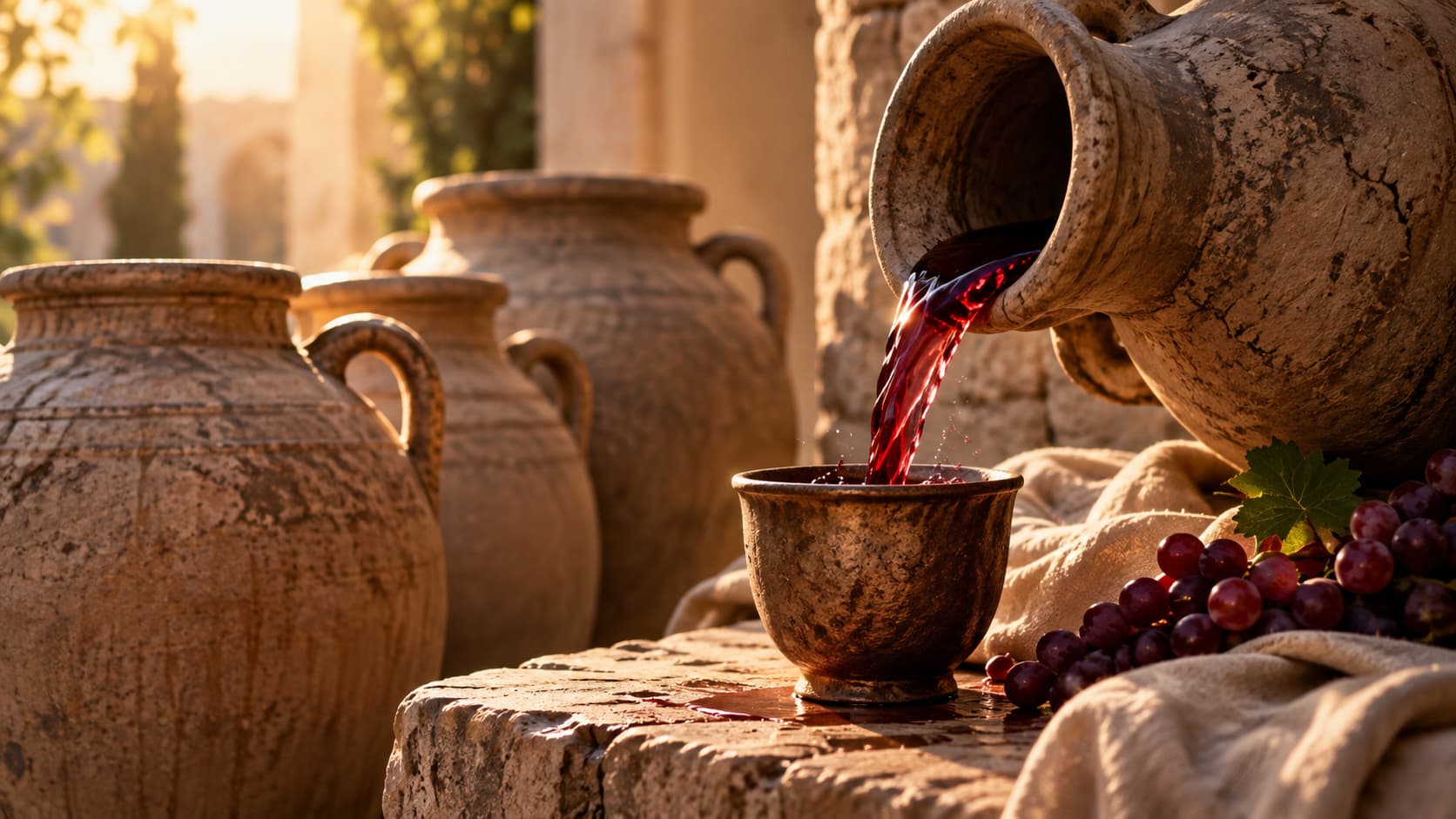
Now, six stone water jars had been set there for Jewish purification, and each contained 20 or 30 gallons.
“Fill the jars with water,” Jesus told them.
So they filled them to the brim.
Then he said to them, “Now draw some water out and take it to the head waiter.”
And they did. And when the head waiter tasted the water after it had become wine, he did not know where it came from, though the servants who had drawn the water knew. He called the groom and told him, “Everyone sets out the fine wine first. Then after people are drunk, the inferior, but you’ve kept the fine wine until now.”
Jesus did this, the first of his signs in Canaa of Galilee. He revealed his glory, and his disciples believed in him.
After this, he went down to Capernium together with his mother, his brothers, and his disciples, and they stayed there only a few days.
May the Lord add his blessing to the reading, the preaching, and your hearing to understand his holy word. May our Lord and Savior Jesus Christ forever be praised.
And all of God’s people say, “Amen.”
Amen. You may be seated.
Dearly beloved, we are gathered here today in the sight of God and of these witnesses to join together this man and this woman in the bonds of holy matrimony, which was instituted by God in the Garden of Eden and blessed and beautified by our Lord by his first miracle in Canaa of Galilee.
You’ve heard that phrase before. I have it memorized because it’s in my little black minister’s manual, the standard wedding. And that’s where it comes from.
The very first miracle that Jesus publicly performed was at this wedding in Canaa of Galilee.
Let’s settle this at the very beginning of the sermon. Write this down if you need to.
There was real wine at the wedding of Canaa.
There was real, real wine at the Last Supper. There was real wine at every Jewish feast and every Jewish celebration. And at every Jewish dinner table where they could afford anything else, there was real wine.
Okay, let’s settle that at the very beginning.
Now, our Baptist tradition of caution towards wine and strong drink has great wisdom in it because the best way not to get burned is don’t ever play with fire.
But today, we’re not here to defend a tradition. We’re here to discover truth. Amen.
And what we find in John chapter 2 is not a lesson about wine. It is a revelation about Jesus.
Up to this point in John’s Gospel, Jesus has called his first disciples. He’s been identified as the Lamb of God at his baptism. But he has not yet done anything publicly miraculous.
No one has been healed. No 5,000 has been fed. Nothing like that has happened.
But that is all about to change.
And so we begin this morning, as in all of the sermons from this series, by retelling the story.
Thankfully, this story is only in one Gospel, John, not all four where I had to combine them last week.
By the way, there’s still some copies of that available back there in the vestibule on the table. If you would like the full story from last week that I didn’t have time to do all the details of, I have it for you. It’s on the table in the vestibule.
But let’s retell this story.
John tells us that Jesus—this is important—Jesus, his mother, and his brothers...
Jesus had brothers and sisters. You got that, didn’t you?
And his disciples were invited to a wedding in Canaa of Galilee.
And this is important as well because a Jewish wedding was not like the kind of weddings that we have today.
In the first century, it was not a two-hour ordeal with a little ceremony and a long reception. It was a multi-day celebration. Families planned for it. Whole communities gathered for it.
Hospitality was a matter of honor in this culture.
And to run out of wine wasn’t just inconvenient.
It was humiliating to the family. It would have brought shame on the groom’s family. Long-term embarrassment.
Seventeen years later, when the people saw that couple walk by, they would say, “You know, that was the couple that ran out of wine at their wedding.”
People would have never forgot about it. It would have brought social disgrace. It would have lingered on. It would have been a dark shadow on the whole happy occasion.
Wasn’t just a minor problem.
It was a public disaster that was about to unfold.
And Mary saw it in the background.
She was that type of woman. The type of woman that I so appreciate. Those church women in the background who see something that’s not just right or something that’s going to snowball into some bigger problem, and you know what they do?
They fix it. They get it taken care of.
And Mary was that kind of woman.
And she comes to Jesus and she says, “They have no wine. Their wine is gone.”
And then we see that little exchange between Jesus and Mary. And the exchange there between Jesus and his mother, in our language as we read it, may feel a little bit awkward if we read it with our modern eyes and hear it with our modern ears.
But in that day, in the Jewish culture, it was not disrespectful. It was affectionate. It was familiar. It was tender because Jesus loved his mama.
It would be like Jesus saying something like we would say when our mama comes to us with an issue, and maybe we’re preoccupied at the time, or maybe we don’t think it’s the most important thing right now, and our mama comes up to us with something and we say, “Mama, really? Mama? Anybody else? Mama? Mama? Mama?”
That wasn’t gonna work, was it?
No, no.
Because I believe in between verses four and five there that Mary shot Jesus the mama look, and that’s all it took.
So think about this.
Why did Mary—Mary sees a problem is coming. Mary knows this dear family, whom she obviously knew, maybe was related to. She sees this public disaster about to unfold.
Why did she come to Jesus with this problem?
Let me be clear about something, folks.
What you’re about to hear is some sanctified speculation.
This is not history. This is not doctrine. This is just me. Okay?
As a matter of fact, I can’t find in my studies, or the studies when I preached this sermon in 2017 in a different way, I can’t find anybody else who agrees with me, anyone else who even mentions this.
This is just me. Got it?
So, you’re not gonna go home and say, “The Bible says...” You’re not gonna say that, are you?
Okay, here we go. You ready?
Jesus was a bachelor.
Mary was a widow.
In that culture, Jesus would have lived then with his mama to take care of his mama.
Mary knew who Jesus really was. The angel had told her. Remember, the angel told her when he was born who he really, really was.
She knew who he was.
So there’s nothing to keep secret between Mary and Jesus.
And while we’re told that Jesus has never performed any public miracles, that does not mean that he never did anything miraculous at home, maybe to help his mama out.
Now, are you ready for this?
I suspect that Mary sees they’re about to run out of wine, and she immediately remembers sitting at the dinner table and giving Jesus his plate for this adult man, her bachelor son.
“Here’s supper tonight.”
And there’s water she begins to pour. And that’s out of the ordinary because they would have always had wine unless money was tight that month.
And she saw Jesus already do this miracle once before.
She goes directly to Jesus, and all she has to say is, “Hey, they’re about to run out of wine.”
And Jesus takes over from there.
After Mary, I believe, shoots Jesus the mama look, she says one of the greatest faith statements in all the Bible.
Mary says to the servants, “Hey, just do whatever he says.”
That’s it.
No instructions, no explanations, no logical exegesis.
Just obedience.
“Hey, y’all just do whatever he says.”
There were six large stone jars nearby. They would have been used by the Jews as ritual handwashing. They didn’t know that the ritual was actually for their own hygiene.
And Jesus tells the servants, “Fill those big old jars up with water.”
They did.
Then he says, “Now draw some out.”
They did.
And in an instant, without grapes, without vineyards, without fermentation, without aging or time, Jesus did what only the Creator could do.
The water became wine. Amen.
The water became wine.
And not just wine, it became the best wine.
The master of the feast, the master of ceremonies, the host tasted it and said, “Well, everybody else serves the good wine first. And after everybody’s gotten happy in their wine, then they start serving the inferior stuff where people won’t even notice.”
And John tells us, the last verse we read, second to the last verse, this the first of his signs Jesus did at Canaa, and his disciples believed him.
Thus, he had done his first public miracle. Amen.
Retelling this amazing story.
Number two then, remembering the truths.
Remembering the truths.
Number one, Jesus is not some cosmic killjoy.
Jesus chose a wedding, not a funeral, for his first miracle.
He stepped into joy. He stepped into celebration. He stepped into community.
Later on in chapter 15, Jesus is going to say, “I have told you these things so that my joy may be in you and your joy may be complete.”
What I told the boys and girls, sometimes we forget about inviting Jesus to the joyous occasions.
We invite Jesus in when somebody’s sick and somebody’s maybe at their death’s door. Call the preacher to come read scripture and pray and hold their hand.
Or maybe a great tragedy has happened. Invite Jesus. Absolutely. Jesus, come near to us.
Maybe there’s a great confusion or there’s this really bad hurdle, this burden to get over. Invite Jesus into it.
But do we invite Jesus to our birthday party?
I was at a birthday party last Saturday.
Two of my nieces have birthdays within days of each other, and we always have their birthdays together. And we had it at the skating rink in Meridian.
And we got there, and there’s 25, 30 kids. They’re all roller skating around, and we didn’t like the DJ’s playlist. So my brother-in-law Ben got in there and changed it up to worship music like we sang this morning.
And so what it was, all these boys and girls are skating around the skating rink, and the lights are flashing, and a disco ball is turning, and they’re praising Jesus.
Why?
Because we invited Jesus to the birthday party.
Invite Jesus to the happy celebrations, and it will be more happy.
Invite Jesus to the wedding. We hope so.
But better than that, invite him to the marriage. Amen.
Invite Jesus into all the seasons of life because he’s not a cosmic killjoy.
No, Jesus brings the joy. Amen.
Truth number two, Jesus cares about what embarrasses us.
Now, this miracle didn’t solve a global crisis. It didn’t even save somebody’s life.
It might have saved a marriage.
It saved a family from shame.
But folks, Jesus cares about what we think may be too small to bother him with.
“I don’t want to bother Jesus with that.”
He wants all parts of your life, folks.
No need is insignificant to him.
Jesus cares about the things, the everyday things, the things that will never make the history books. They may not even ever make the local newspaper, such that it is, and not even make a Facebook post.
So small, so insignificant.
But if it matters to you, it matters to Jesus. Amen.
Jesus cares.
That’s the message.
Jesus cares.
Truth number two.
Truth number three, obedience often comes before understanding.
Now, some of you who have been keeping up and taking notes may notice that this truth has been in about five or six or seven of the 19 sermons in this series.
Maybe we need to pay attention to that, huh?
Obedience often comes before understanding.
What did Mary say to the servants?
“Just do whatever Jesus tells you to do.”
The servants didn’t know why. They didn’t know how. They didn’t know what was going to happen next.
Why fill the great stone jars up again? The ceremonial washing already happened. They usually do it at that great big stone jug is where they do it.
Why are we pouring more water in?
Why are we drawing water out?
That’s just not something that we would do.
They just obeyed.
They just did what Jesus said.
And when they did, listen, their obedience, even though they didn’t have understanding, their obedience opened up the space, really created the space for the miracle.
Sometimes the miracle that you’re waiting for is not going to happen until you obey without understanding to open up, to create the space for that miracle to happen.
That’s what happened here.
The obedience.
Blind obedience.
Yeah.
Look, I’m not going to just blindly obey anybody, but I’m going to blindly obey Jesus. Amen.
Don’t just blindly obey anybody in anything somebody says.
But Jesus? Yeah, I’m going to just blindly do whatever he tells me to do.
I’m going to do what his mama said. I’m going to follow mama’s orders.
Just do whatever Jesus tells you to do. Amen.
Truth number four, and I love this.
Oh, here’s where it gets so good.
Jesus has the power to transform completely.
Folks, to understand this miracle, you’ve got to understand the grandness, the bigness of this miracle.
And we may look at this and say this is not a great miracle like walking on the water or raising Lazarus from the dead.
Or this may be the greatest miracle in the whole New Testament other than the resurrection of Jesus.
To understand this miracle, you got to understand winemaking.
Takes years of cultivation, choosing the right kind of vine slips and rooting them and getting them in the right soil with the right acidity and growing them off and pruning them.
And getting when the fruit starts setting, going out there every day, sometimes twice a day, because they’ve got to be picked at just the right moment.
They’ve got to be picked or they’ll not have enough sugar, or the sugar will begin to turn into starch like sweet corn, and you got to get them just the right time.
And then you got to crush them with the right kind of feet. They used feet to crush them back then.
Then you’ve got to put them in the vats to go through the process of fermentation, and you got to be tasting it constantly to get it just right.
If you go too long, if you get it out too soon, it’s going to spoil because they didn’t have pasteurization.
And if you get it out too late, it’s going to have turned into vinegar.
Everything has got to be timed perfect.
It is a process.
Then you have to put it in the wineskins and grade it and set aside the inferior and mark the better.
And all of this has to happen. All this has to happen exactly perfectly.
It takes skill.
It takes time.
It takes hard work.
And Jesus did it just like that.
Look, Jesus did a miracle at the atomic, molecular, chemical level, turning H2O into something complex chemically.
Do you know what that means?
It means that Jesus can turn a broken marriage into a joyful home.
He can transform completely.
It means that Jesus can take a broken heart and put it back together because he can transform completely.
It means that Jesus can take chains of slavery and turn them into complete freedom because he can transform completely.
It means that he can take lost sinners bound for a devil’s hell and turn them into saved saints bound for eternal life. Amen.
Because he transforms completely.
If he can change water into wine, he can change you. Amen.
Number three, responding with faith.
Because all these truths are not meant just to see and to observe, but to have a decision.
Number one, invite Jesus into every area of your life.
Not just the spiritual moments, not just the somber moments, not just the desperate moments, but into the celebrations, into the relationships, into the ordinary days.
Every day, invite Jesus into everything in your life.
Number two, bring your needs to him.
Bring them honestly. Bring them humbly.
There is no need so small that Jesus does not care about. There is no need so large that Jesus cannot meet. Amen.
Mary didn’t have to make an explanation. She just trusted and told the servants.
The servants obey.
Just do what he says.
Number three, obey then even when it doesn’t make sense.
Faith in Jesus does not require you to understand.
Faith in Jesus requires you to surrender.
Number four, trust that Jesus is still in the business of transformation.
Nothing you bring to Jesus ever stays the same.
It just gets better. Amen.
So, here’s our final thought in conclusion.
So, Jesus turns the water into wine, and the master of ceremonies tastes, and he is just astounded because nobody does this.
Everybody saves that old cheap stuff for the last.
Jesus’s wine he made was better than anything ever served before.
And that’s how it always works with Jesus.
With Jesus, grace gets richer over time.
With Jesus, hope grows stronger over time.
With Jesus, joy gets deeper over time because he saves the best for last.
And if you walk with him long enough, you’ll discover something beautiful.
If you’ll walk with Jesus, give your life to Jesus, and walk with Jesus until your last breath on earth, you’ll find out this beautiful truth.
With Jesus, the best is yet to come.
Come to Jesus.
Heavenly Father, I pray this morning, thanking you so much that we have a record of this glorious moment in the Gospel account.
I pray that people have heard this message and now, in this time of invitation, that people will respond.
Lord, you’re calling some to be saved and to make the good confession of faith and come forward for believer’s baptism, others for other decisions.
Whatever they may be, let people come.
Even in this small crowd, maybe it needs to be this small crowd this morning for someone to make their decision public.
But whatever it is, let them come.
For we pray in Jesus’ name.
And all of God’s people say, “Amen.”
And amen.