
Great Stories. Eternal Truths.
Part 20, Woman at the Well
Watch Sermon
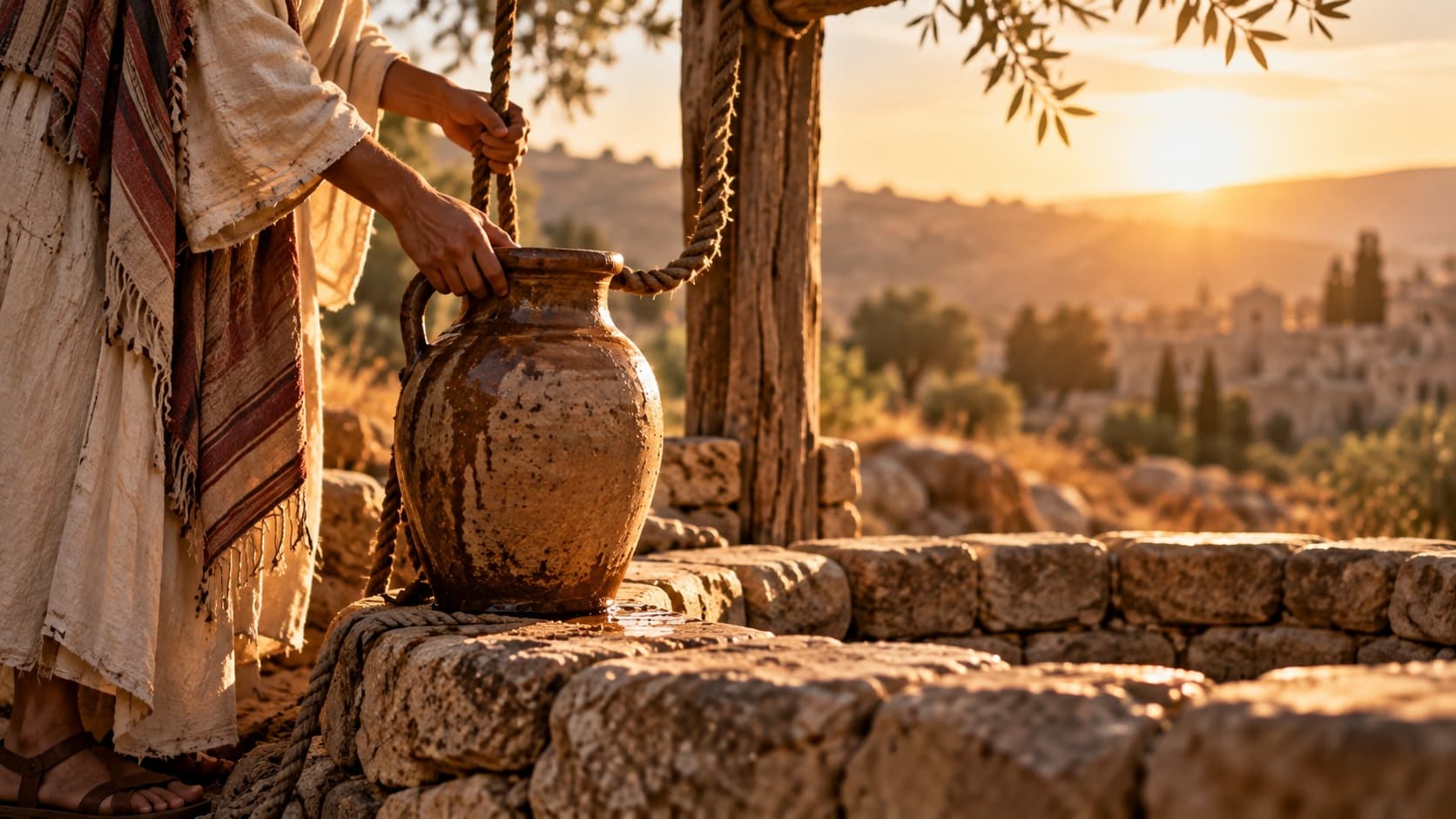
She came to the well expecting to draw water, but she left having encountered the One who already knew her entire story. In John 4, Jesus crosses cultural barriers and meets a Samaritan woman carrying a complicated past, offering her something no ordinary well could provide: living water. Their conversation moves from thirst and brokenness to worship, grace, and ultimately the identity of Jesus Himself. This message reminds us that Christ knows us completely and still invites us to come—and that one genuine encounter with Him can transform an outcast into a witness. The question is not whether Jesus knows your story. He already does. The question is: Have you met Him for yourself?
Scripture Reference
John 4:1-26
Full Transcript
Now hear the word of the Lord.
When Jesus learned that the Pharisees had heard he was making and baptizing more disciples than John, though Jesus himself was not baptizing, but his disciples were, he left Judea and went again to Galilee. He had to travel through Samaria.
So he came to a town of Samaria called Saikar near the property that Jacob had given his son Joseph. Jacob’s well was there, and Jesus, worn out from his journey, sat down at the well. It was about noon.
A woman of Samaria came to draw water.
“Give me a drink,” Jesus said to her, because his disciples had gone into town to buy food.
“How is it that you, a Jew, ask for a drink from me, a Samaritan woman?” she asked him. For Jews do not associate with Samaritans.
Jesus answered, “If you knew the gift of God and who is saying to you, ‘Give me a drink,’ you would ask him, and he would give you living water.”
“Sir,” said the woman, “you don’t even have a bucket and the well is deep. So where do you get this living water? You aren’t greater than our father Jacob, are you? He gave us the well and drank from it himself, as did his sons and livestock.”
Jesus said, “Everyone who drinks from this water will get thirsty again. But whoever drinks from the water that I will give him will never get thirsty again. In fact, the water I will give him will become a well of water springing up in him for eternal life.”
“Sir,” the woman said to him, “give me this water so that I won’t get thirsty and come here to draw water.”
“Go call your husband,” he told her, “and come back here.”
“I don’t have a husband,” she answered.
“You have correctly said, ‘I don’t have a husband,’” Jesus said. “For you’ve had five husbands, and the man you have now is not your husband. What you have said is true.”
“Sir,” the woman replied, “I see that you are a prophet. Our father is worshiped on this mountain, but you Jews say the place to worship is in Jerusalem.”
Jesus told her, “Believe me, woman, an hour is coming when you will worship the Father, neither on this mountain nor in Jerusalem. You Samaritans worship what you do not know. We worship what we do know because salvation is from the Jews. But an hour is coming and is now here when the true worshippers will worship the Father in spirit and in truth. Yes, the Father wants such people to worship him. God is spirit, and those who worship him must worship in spirit and in truth.”
The woman said to him, “I know that the Messiah is coming who is called Christ. When he comes, he will explain everything to us.”
Jesus told her, “I, the one speaking to you, am he.”
May the Lord and his blessing to the reading, the preaching, and now your hearing to understand his holy word. May our Lord and Savior Jesus Christ forever be praised.
And all of God’s people say, “Amen.”
Amen. You may be seated.
Folks, one of the great truths of disciplehip, of making disciples, is this: life change oftentimes, not every time, but oftentimes happens through a conversation.
Not a speech, not a sermon, not a Facebook argument, but a conversation.
John’s gospel here gives us something the other three, Matthew, Mark, and Luke, don’t emphasize nearly as much. John gives us in his gospel a deeply relational, a relationship portrait of Jesus.
John wasn’t just an observer of what Jesus was doing. John is recorded as being Jesus’s closest earthly friend. And he records moments where Jesus slows down, Jesus sits down, and he talks with people, people like you and people like me.
In John chapter 3, the previous chapter to this, Jesus speaks with a man named Nicodemus, a respected religious leader. But Nicodemus comes to him under the cover of night in pitch darkness.
But the next chapter, John 4, where we are this morning, Jesus speaks with a Samaritan woman, totally opposite from Nicodemus, a woman who was socially rejected. And this time, it’s under the blazing midday sun.
They couldn’t have been more different.
And yet, Nicodemus, the religious man in chapter 3, and the woman in chapter 4, who was rejected, they both desperately needed the same thing.
They needed an encounter with Jesus.
This morning’s great story reminds us of this eternal truth. Jesus meets people exactly where they are. Jesus knows where you are this morning. He knows what page of the journey that you are on, and Jesus is ready to meet you on that page of your life.
Amen.
Amen.
And he offers the living water to quench the thirsty souls.
We began where we always begin in this sermon series with number one, a retelling of the story. Just get into your imagination a bit if you can.
Jesus is traveling north from Judea to Galilee. Now, most Jews would go miles out of their way. They would take the long way around to avoid even stepping foot over the border of Samaria.
But John tells us something important here. It says that Jesus had to pass through Samaria.
This wasn’t about geography.
This was a divine appointment.
And Jesus stops at a place known as Jacob’s Well, a historic site. A place still there today. It was a place that reminded of God’s Old Testament promises, the covenant promises he had made through Abraham, through Isaac, and through Jacob.
And Jesus gets there and says he’s worn out. It’s noon. It’s the heat of the day. He’s tired. Jesus is thirsty. He sends the disciples to go to town and get some lunch and bring it back to him.
And he’s sitting there at the well all alone.
And this woman comes, a Samaritan woman.
She’s unnamed in scripture, but if those of you who like trivial things, history calls her Fotina. Some traditions even name her Saint Fotina. That’s not in the Bible, but in tradition.
But this woman comes to the well alone.
And she comes to the well at noonday because nobody would be at the well at noon. You either came early in the morning or you came late in the evening, and she came when nobody else would be there.
That tells us something already.
Then Jesus, who is there, breaks all of the social taboos all at once in that one little conversation.
A Jewish man speaks to a Samaritan. That didn’t happen because the Jews were racist against Samaritans. Let’s just say it like it was. They were racist against the Samaritans and wouldn’t even talk to them.
Jesus did.
A rabbi. Jesus is a rabbi, and he’s speaking to a woman. Rabbis back then didn’t speak to women.
A holy man speaks to someone with a bad reputation.
And he, Jesus, the Jewish man, the rabbi man, the holy man, asks this woman, this Samaritan woman, this Samaritan woman with a worse reputation than the other Samaritans, and he asks her for a drink of water.
Just a drink of water.
The conversation moves quickly from water to life, then to worship, then to truth, and ultimately the conversation moves to salvation.
And Jesus reveals supernatural wisdom, supernatural knowledge about this woman, something that he could not have known in any other way.
He said, “Go back and get your husband and come back here.”
She said, “Well, I don’t have a husband.”
Jesus said, “That’s right. You’ve had five, and the one you’ve got now is not your husband.”
He says this to demonstrate his know—that he knew where she was.
Don’t miss this, folks.
Don’t miss this, folks.
This is not condemnation.
If it was condemnation, when the woman walked to the well, Jesus would have walked away from the well, shook the sand off his sandals, and went the other way.
He engages this woman with conversation, not to shame her, but to show her that I know you, and I, thoughing you, still care for you.
The woman is taken aback, thrown off her feet a little bit, and so she tries what so many times, so many times people try to do. They try to change the subject.
Amen.
And she tries to change the subject.
Here’s a religious man, a rabbi man. And so what can I change the subject with?
Let me go to the controversial.
Let me find something that’s a controversy of our day. Talking about theology, worship locations. You know, you Jews say that we got to worship in Jerusalem, but we worship on this mountain, and there’s a big religious debate about that.
And she was trying to draw him into a different discussion than her own life.
Amen.
And then Jesus does something staggering after she reveals—I hope you noticed this in the scripture reading—after she reveals that she believes that the Messiah is coming.
She said, “I believe that the Messiah is coming, and he’s going to explain everything to us.”
You see there, she already had the kernel, the grain of faith in her soul.
After she says, “I believe the Christ is coming,” Jesus says, “I who am you and he.”
It was one of the clearest self-revelations of Jesus as the Messiah in the entire gospel account.
She leaves her water jar behind, symbolic, intentional, and she runs back to town.
The outcast becomes the messenger.
The shamed woman becomes the witness.
And an entire Samaritan village comes out to meet Jesus.
And folks, the least likely person in the world becomes one of the very first missionaries of the gospel.
Amen.
Retelling the story. Number two, let’s remember the truths, these eternal lessons from the well.
Number one, Jesus seeks the unlikely.
Now, Nicodemus in chapter 3, Nicodemus had credentials. Nicodemus had religion. Nicodemus had education. Nicodemus had wealth.
But this woman, all she’s got is a reputation.
Nicodemus came under cover of darkness so nobody would see him. This woman comes at noon to the well so that nobody will see her.
And you know what she found there?
Jesus was already there waiting for.
Amen.
Folks, there’s no category of person beyond the reach of Christ.
There is no category of person beyond the love of God.
High society or low, religious or rejected, educated or ignorant, rich or poor, brown or beige, it does not matter.
Christ has come for us all.
Amen.
Amen.
Jesus seeks the unlikely. Number one.
Number two, Jesus knows us completely and still offers us grace.
Do you recognize something for your own personal life in this encounter?
Jesus already knew the woman’s story. Jesus already knew the woman’s sorted past, and he still engaged her with the gospel.
The good news, folks: Jesus already knows your story.
Amen.
Jesus did not discover or uncover this woman’s past. He already knew it.
And he had to go through Samaria. He had to go through Samaria instead of walking around it like all the other Jews would so that he would encounter this woman.
He did not avoid it, but he also did not weaponize it.
There’s a message here for the church.
There’s a message here for the religious.
Listen carefully.
For the church. For the religious.
He didn’t avoid her sorted past, but he did not weaponize it either. He confronted her sin without condemnation. He offered a life that the sin could never compare to.
Our truth to remember is this, folks.
Grace.
How many of you want grace?
How many?
I want grace.
Grace is not ignorance of sin.
Grace is mercy when there’s full knowledge of sin.
Ephesians chapter 2: “For we were dead in our trespasses and sins. And God in his rich love, and the rich love wherewith he hath loved us, made us alive in Christ, even when we were dead in our trespasses and sins.”
Romans chapter 5: “But God demonstrates his own love for us in this, that while we were yet sinners, Christ died for us.”
Amen.
Number three, I always try to have one of these truths to remember to be one that’ll make your toes scrunch up.
This is the one.
Number three, folks, everyone worships something or someone.
This woman, when Jesus confronts her with her life, her past, and her sin, she tries to redirect the conversation towards a controversy of the day about where’s the place we ought to worship.
How should we be worshiping?
I don’t know what that controversy would be today. I think we’ve gotten through most of the worship wars of the ’90s and 2000s, but it’d be something like that back then.
They’re worshiping the wrong way over there. What’s the real way we’re supposed to worship?
But Jesus completely reframes the issue.
It’s not about where you’re worshiping.
It’s about what you’re worshiping.
Amen.
The question isn’t where you worship, it’s who you worship.
Jesus says then the true worshippers worship in spirit and in truth. He says that worship is not about style. Worship is not about buildings. Worship is not about preferences.
Everyone, this woman included, and every one of you included, everyone worships something.
Do you want to know how you can determine what you truly worship?
Do you really want to know how you can determine what you really worship?
You’re thinking about whether or not to give me permission to tell you or not.
You look at your calendar and you see what takes most of your calendar.
You look at your checkbook and you see what takes most of your money.
Then you look at your heart and you honestly say, “What brings me the most happiness and joy? What do I spend all my time thinking about?”
And that will reveal what you worship because everybody worships something.
Disciplehip, what I mentioned to the very beginning, disciplehip always produces worship.
If what we’re doing and calling it disciplehip is not producing worship, it’s not disciplehip.
Worship is produced as disciples are made.
Jesus—knowing Jesus fuels real worship.
If you just can’t sing to worship, it may be because you don’t know Jesus.
Jesus results in worship.
There’s just no other way around.
Truth number four, a simple testimony has extraordinary power.
We stopped reading at verse 26, and verse 27 and following is when the disciples come back, and the woman’s gone, and Jesus says, “I don’t need bread. I’ve got bread you know not of.”
And then verse 39.
Verse 39, look in your Bible again.
Verse 39, it picks up again the story of the woman.
Verse 39: “Now many Samaritans from that town believed in him because of what the woman said when she testified, ‘He told me everything I ever did.’ So when the Samaritans came out to him, they asked him to stay with them, and he stayed there two days. And many more believed because of what he said. And they told the woman, ‘We no longer believe because of what you said, since we’ve heard for ourselves and know that this really is, this really is the Savior of the world.’”
A simple testimony.
A simple testimony has extraordinary power.
Folks, this woman did not go back to town and preach theology. She didn’t argue doctrine.
She just comes and says, “Come see a man. Told me everything I ever did.”
And probably some old km that heard it said, “Well, he must have been talking for a long time if he told you everything you’ve ever did.”
But she gave the testimony.
Come see this man.
That’s it.
Come see this man.
You just would not believe this man.
And her testimony sparks curiosity, and the curiosity leads to an encounter, and the encounter leads to belief, and the belief leads to saving faith.
Folks, people don’t need your eloquence.
They need to hear your experience.
You don’t have to have the most polished testimony. You just need to tell people what Jesus has done for you.
You just need to tell people the experience you have had with Jesus.
They don’t want a long, drawn-out thing that’s so organized and meticulous.
No, just tell somebody what the Lord has done for you.
Amen.
Simple testimony can have extraordinary power.
Number three, responding with faith.
How do we respond to this story? Because like them all, we’re not supposed to just see the story. We’re supposed to respond to it.
How do we respond?
We come to Jesus honestly, not pretending.
Bring your doubts to Jesus.
Jesus is big enough for your doubt.
Bring your sin to Jesus.
He already knows it.
Bring your trauma and your deep hurt to Jesus.
He and he alone can heal it.
Come to Jesus honestly.
Not pretending, not hiding, not cleaning yourself up first.
Bring your thirst to the living water.
Bring your failures to the Savior.
Bring your shame to Jesus.
Jesus already knows, and he still invites you.
Come to Jesus honestly.
Number two, worship Jesus fully.
Worship Jesus fully.
Ask yourself in all honesty, what is it that excites you the most?
What is it that consumes your thoughts?
What is it that gets your best, your emotional energy?
What is it that really gets you charged up?
And then ask yourself, is Jesus worthy of more than what I’m giving him?
Am I giving Jesus the best of all of me, or am I giving Jesus just what’s left over at the end?
Come to Jesus honestly.
Worship Jesus fully.
Share your story boldly.
Say that again.
Share your story boldly.
You don’t need a sermon.
You don’t need the perfect words.
You need obedience.
Just be obedient.
Your story may be the spark that leads someone else to meet Jesus for themselves.
So, let’s conclude with this.
Have you met this Jesus?
The people of Samaria said it best. “Now we believe not because of what you said”—they’re saying to the woman—“but because we’ve heard him for ourselves.”
Folks, you can’t live on borrowed faith.
You can’t live on second generation faith.
You can’t drink secondhand water, nor would you want to.
So, here are the questions this great story leaves us with.
Have you met Jesus for yourself?
And if you have, who are you telling about your encounter with Jesus?
“Come see this man who told me everything I ever did.”
Heavenly Father, we pray this morning, thanking you. Oh, thanking you for your grace.
Thanking you, Father, that we don’t have to become worthy before coming to you, but we come to you just as we are.
We come to you warts and all.
We come to you, and we don’t find condemnation.
We find a call to forgiveness.
We find redemption.
We find the living water.
Father, I pray that if someone here today needs to have that encounter, that they will.
We pray in Jesus’ name.
Amen.