
Great Stories. Eternal Truths.
Part 24, The Transfiguration
Watch Sermon
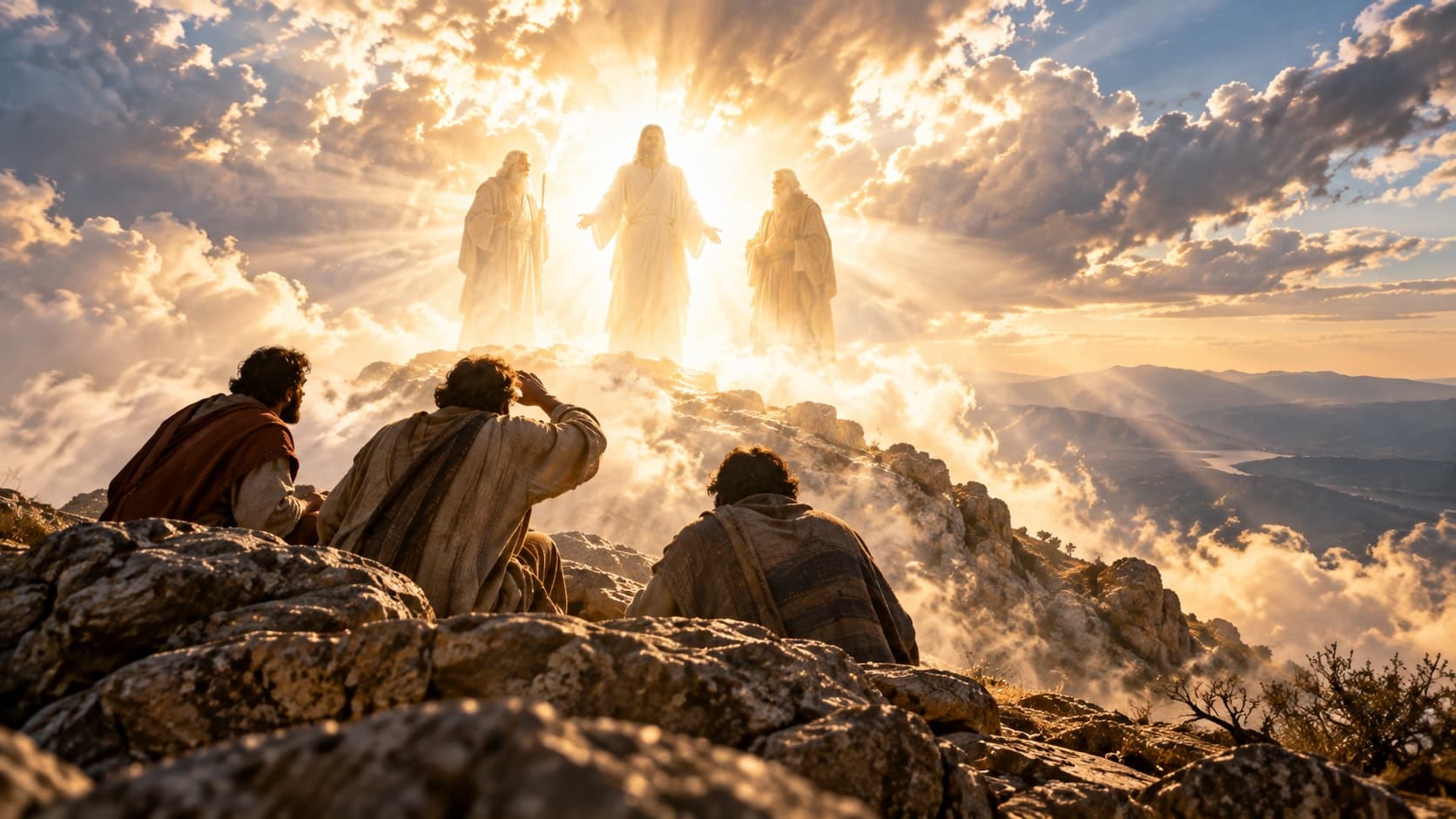
On a mountain with Peter, James, and John, the veil is briefly pulled back and Jesus is revealed in radiant glory. Moses and Elijah appear beside Him, the Father speaks from heaven, and then, when the cloud clears, the disciples see only Jesus. The Transfiguration offers a breathtaking glimpse of who Christ truly is and points toward the glory still to come. But mountaintop experiences were never meant to last forever. Eventually, the disciples had to return to the valley below. This message explores what the mountain teaches us about Jesus, eternity, suffering, and hope—and why the glory we encounter on the mountain should change the way we live when we return to the valley.
Scripture Reference
Matthew 17:1–8
Full Transcript
...Matthew’s Gospel is where our opening text will come from today. Matthew’s Gospel, chapter 17. Matthew 17 and verse one.
As it is in all of these sermons in this series, this is a compilation of Matthew, Mark, Luke, and John. But we’re going to read, to begin with this morning, Matthew 17. Matthew 17, verse one.
When you get there, if you’re able, would you stand with me as we honor God and the reading of his word?
And now hear the word of the Lord.
After six days, Jesus took Peter, James, and his brother John and led them up on a high mountain by themselves.
He was transfigured in front of them, and his face shone like the sun. His clothes became as white as the light.
Suddenly Moses and Elijah appeared to them, talking with him.
Then Peter said to Jesus, “Lord, it is good for us to be here. I will set up three shelters here: one for you, one for Moses, and one for Elijah.”
While he was still speaking, suddenly a bright cloud covered them. And a voice from the cloud said, “This is my beloved Son, with whom I am well pleased. Listen to him.”
When the disciples heard this, they fell face down and were terrified.
Jesus came up, touched them, and said, “Get up. Don’t be afraid.”
When they looked up, they saw no one except Jesus alone.
May God add his blessing to the reading, the preaching, and your hearing to understand his holy word. May our Lord and Savior Jesus Christ forever be praised.
And all of God’s people say, “Amen.”
Amen. You may be seated.
Mountaintop experiences.
Now, I hope that you have all had mountaintop experiences of both kinds. There are the literal mountaintop experiences where you travel to the mountains, and there’s something about the mountains. That sunset and that sunrise in the mountains is just something special. Amen.
Now, I’m more of a beach person, and I fully confess that. And the sunsets on the beach, to me, are just absolutely glorious.
But the mountains, too. There are those literal mountaintop experiences. Many of the young adults here were with me when we went up on the mountain, Covenant College, with camp, and that castle in the clouds. And we had those great literal mountaintop experiences that were also great spiritual mountaintop experiences.
But today we’re going to see where that analogy comes from. We’re going to see something that happened on the mountain.
It’s Mount Tabore. We don’t get that in Matthew, but Mount Tabore.
This mountaintop experience that changed three of the 12 disciples changed them forever.
And I pray that it also changes us forever.
This morning, with retelling the story, number one, I’m going to—and I do try to find novel ways to retell the story—but I’ve got to give you a warning before I do it this morning.
I’m going to retell the story from Elijah’s perspective.
Elijah was there on the mountain, but Elijah had gone to heaven 900 years before this happened. So, I’m telling you this ahead of time. This is not new revelation. This is Brother Kurt biblically informed—what do I call it?—spiritual imagination.
But I think that this can help us maybe connect with the story from Elijah’s perspective.
Are you ready?
It had been 900 years.
Nine centuries since I stood on Mount Carmel. Nine centuries since fire fell from heaven. Nine centuries since I outran Ahab’s chariot. Nine centuries since the whirlwind carried me to heaven.
But in glory, those 900 years barely felt like a day. You see, time does not weigh on eternity the way it weighs on earth.
And then came the summons. A command, not loud, not rushed, but sovereign. A holy commission from the Father and his throne.
“Elijah, go.”
There was no explanation needed. There was no confusion about the mission.
I knew the one I had spoken of, the one the prophets had foretold, the one sacrifices anticipated, the one greater than all of our sermons and prophecies: the Son.
I had preached repentance. I had confronted kings. I had called down fire on the prophets of Bael.
But I’d only been a voice.
He, the Son, was the Word.
And now I was being sent not to preach about him, but to stand beside him.
When Moses joined me, we did not speak long. We both knew why we were going.
The law and the prophets together again, not as rivals, not as equals, but as witnesses, the two witnesses.
The mountain then appeared beneath us, and there he stood, not as I had seen him from afar in the prophetic shadow, but unveiled, radiant.
That glory was not borrowed. It was not reflected. It was his own glory.
His face shone brighter than Carmel’s fire. His garments flashed whiter than lightning.
And for the first time in my existence, I fully understood every prophecy, every confrontation, every lonely moment by the brook at Cherith, every cave of my despair, every whisper of the still small voice.
And it all pointed to him.
We, Moses and I and Jesus, spoke of his departure, his exodus.
How fitting that Moses stood there.
The greater Exodus was coming, not from Egypt, but from sin. Not through a sea, but through the cross.
And as we spoke, I felt something. I felt something holy.
Anticipation.
Not fear. Not uncertainty.
The cross was not going to be a defeat. It was a design.
Then I heard it again.
The voice.
The same voice that had whispered to me 900 years ago in the cave. But now, not a whisper. It was a thunder from the cloud.
“This is my beloved Son. Listen to him.”
I’d once stood alone against the prophets of Baal, but now I stand in awe of the true prophet.
And when the cloud began to lift, when the moment began to fade, I knew my assignment was complete.
We, Moses and I, had not come to remain.
We had come to affirm.
When the light settled and the disciples lifted their trembling heads, they saw no one except Jesus, as it should be.
The law, step aside.
The prophets, step aside.
Even glory’s witnesses, step aside, so that only the Son may stand alone.
And in eternity, I can tell you this.
900 years was nothing.
The weight was nothing.
Because in that moment, on that mountain, all of history converged. All of prophecy breathed. And all glory focused, focused on him, on Jesus alone.
And all of God’s people say amen.
And there’s a bit of glory there in that Elijah was there. Amen. And Moses was there with Jesus on that mountain.
We retell the story in a bit novel way to retell it this morning.
But then, number two, we remember the truths, because we are to glean the truth from this.
Truth number one is this.
The transfiguration of Jesus reveals truth about the relationship within the Trinity.
Follow with me, if you will.
On that mountain, heaven pulled back the curtain. On that mountain, the Son, Jesus, stood in radiant glory. His clothes, his face, his hair. Jesus was on the mountain.
The Father spoke from the cloud. The Spirit overshadowed in divine presence.
Folks, this was not three gods here. This was not one God wearing three masks here.
This was the eternal fellowship of God the Father and God the Son and God the Holy Spirit.
The Father delights in the Son. The Son obeys the Father. And the Spirit manifests the glory.
Folks, before there was a mountain, before there was a cross, before there was anything in this world, there was love within the Holy Trinity.
And when the Father says, “This is my beloved Son,” we are overhearing. We are eavesdropping on the eternal affection, the eternal love in heaven.
There has been love between the Father, Son, and Holy Spirit in heaven long before Adam and Eve were ever made in the Garden of Eden.
Before any of us existed, in eternity past, all three have always been.
In John 17, we read—we’re in Matthew—but in John 17:24, we read, “Father”—Jesus is saying this—“Father, I desire that they also whom you have given me be with me where I am to see my glory.”
The glory on that mountain, folks, was not new.
The glory on that mountain was ancient glory.
Not new glory.
Eternal glory.
And listen to me, beloved.
Listen.
Salvation.
Salvation. Being born again invites us into that same fellowship of divine glory.
Amen.
Truth number two, the transfiguration of Jesus reveals truth about the fulfillment of the law and the prophets.
Moses stood there, the law.
Elijah stood there, the prophets.
The law and the prophets, the whole Old Testament, are embodied there in two men.
But when the cloud lifted, the Bible says, who was left there with them?
When the cloud lifted, Jesus and Jesus alone was there.
Not Moses and Jesus.
Not Elijah and Jesus.
Jesus only.
Listen to me. You’ve got to get this.
The law, Moses, points to Jesus.
The prophets, Elijah, proclaim Jesus.
All of Scripture, though, culminates in him, in Jesus.
The Father did not say, “Listen to them.”
The Father said, “Listen to him.”
Hebrews 1:1 and 2: “God, who at various times and in various ways spoke in times past to the fathers by the prophets, has in these last days spoken to us by his Son.”
You—I—you’ve got to get this, folks.
It’s all about Jesus.
Moses prepared the way.
Elijah announced the way.
But Jesus is the way.
Truth number three, the transfiguration of Jesus reveals truth about the life to come.
I wonder if you can handle a little bit of glory yourself this morning.
Can you?
Moses—Moses had died centuries earlier, 1,500 years earlier.
Elijah had been taken up in a whirlwind to heaven 900 years earlier.
And yet there they stood, alive, aware, having a conversation, and recognizable.
Remember what I told the boys and girls about them not having a photograph or a picture, any way to take Jesus’s picture?
They surely didn’t have it.
There were no pictures of Moses and Elijah. There was no way for the disciples, Peter, James, and John, to know it was Elijah and Moses except for the divine glory revealing them.
Here’s what I want you to see.
Death did not erase them.
Heaven does not erase you.
Heaven does not erase who you are.
Heaven does not erase your personality.
Glory does not dissolve your identity, folks.
When we get to heaven, we’re not going to be just absorbed into the light like some kind of mythological stuff we get told today.
I’m not going to be absorbed into the light.
I’m going to be me.
And you’re going to be you.
We will know and be known.
1 Corinthians chapter 13, the love chapter. And Paul’s talking about love is patient, love is kind, it does not envy, it does not boast, it is not easily angered.
He goes all the way, chapter 13, all the way down to verse 12, where he says, “Now I know in part, but then, in heaven, I will know fully even as I am fully known.”
Folks, heaven is not less personal than earth.
Heaven is more personal.
We are more who we are.
I will know you, and I will be fully known by you if you’re with me there in heaven.
Amen.
The transfiguration tells us—I love this, folks—the transfiguration of Jesus tells us that the grave is not the end.
The story continues.
Truth number four, the transfiguration of Jesus reveals truth about the temporary nature of mountaintop experiences.
Mountains are glorious. There’s no doubt about it.
But they are not our permanent address.
I don’t think anybody has a cabin in the mountains here. If so, you’ve never offered me to stay a weekend or anything.
The mountain was not the permanent address.
They had to come down from the mountain.
And at the bottom of that mountain—we’re going to get the next chapter—the bottom of that mountain, there was a demon-possessed void just waiting for them.
There was brokenness waiting for them.
At the bottom of the mountain, there was chaos waiting for them.
At the bottom of the mountain, there were people in great need waiting for them.
At the bottom of the mountain, they had to come down from the mountain.
God gives us glimpses of glory, but not to escape the valley below, but to prepare us for the valley below.
You cannot live on yesterday’s mountaintop.
You’ve got to come down from the mountain with the glory that was revealed to you to serve in the valley.
2 Corinthians 4:17 says, “For our light affliction is working for us a far more exceeding and eternal weight of glory.”
The mountain strengthens us.
The mountaintop experience forms us, disciples us, transforms us.
The mountaintop experience is experiencing the glory of God.
That’s on the mountain.
But ministry happens in the valley.
So we’ve got to come down from the mountain.
Truth number five, the transfiguration of Jesus reveals truth about hope.
I love springtime because springtime is the exemplar of hope.
Of hope.
That’s why on the sign out front it says, “Hope springs eternal.”
Now the cross was coming for Jesus.
Jesus knew the cross was coming.
The rejection of their Messiah by the Jews was coming. He knew it was coming.
Blood was coming.
The whipping, the beating, the crown of thorn.
It was all coming.
But before Calvary, before Goltha, God gave a preview of glory.
The transfiguration of Jesus whispers what the resurrection is about to shout.
That this is not the end.
We have our hope in glory.
The one who shines on that mountain will rain on the earth.
The glory that flashed on that moment will one day fill the entire being of who we are.
Romans 8:18 says, “For I consider that the sufferings of this present age are not worthy to be compared with the glory which shall be revealed in us.”
Folks, the transfiguration of Jesus is a down payment on our destiny.
It tells us that suffering is temporary.
It tells us that glory is certain.
It tells us that Jesus wins.
And if you are in Christ, you share in that glory.
And if you are not in Christ, you can be in Christ today.
And so we respond with faith very quickly.
Responding with faith, the transfiguration was not given merely to be admired.
It was given to be obeyed.
The Father did not say, “Analyze him.”
The Father did not say, “Debate him.”
The Father said, “Listen to him.”
So how do we respond?
We respond by worshiping the triune God in all of his glory.
How do we respond?
We respond to listening to Jesus above all other voices.
Moses was great.
Elijah was powerful.
But the Father said, “Listen to Jesus.”
We live in a world full of voices. Cultural voices, political voices.
Oh, are we ever going to get through a political season and have it over with for at least six months?
Tradition has its voices.
Opinions of everybody around us.
Even church history has voices.
But all of it must bow to Jesus.
Listen to me very carefully.
You got to get this, folks.
If Jesus contradicts your preferences—if Jesus contradicts your preferences and what you want—his voice wins.
If Jesus confronts your habit, he’s right.
If Jesus calls you forward, it is not a negotiation.
You just follow.
When Jesus speaks, friends, when Jesus speaks, the discussion is over.
Respond by listening to Jesus.
Respond with hope about the life that is to come.
Moses and Elijah on that mountain were alive.
Heaven is real.
Glory is coming.
If you’re grieving today, remember this.
Death does not have the final word.
If you’re aging today, remember this.
This body is not your forever body.
If you are discouraged today, remember this.
This world is not my home. I’m just passing through. If heaven’s not my home, oh Lord, what could I do? The angels beckon me from heaven’s open door. Oh, I can’t feel at home in this world anymore.
Respond with hope about the life to come.
Respond with humility about what you don’t understand.
I don’t have time for this, but I’m going to share it anyway.
Peter spoke too quickly, didn’t he?
“Oh Lord, let us build three tents and we’ll all just stay here.”
He meant well.
Peter meant well.
But he misunderstood.
And so do we.
Some of you are walking through things that you can’t understand.
Some of you are walking through things, like Peter was, that you can’t explain.
There are some doctrines that stretch your mind, and when you really sit down and you start thinking about it, it feels like that rubber band’s about to snap.
Sometimes some of your prayers feel unanswered.
Friends, sometimes you just have to wait longer on that prayer to be answered than was thought of.
The Lord’s going to answer it in his time.
Amen.
Here’s the response.
Trust anyway.
God is not confused even when you are.
Pray this simple prayer: “Lord, I don’t understand, but I trust you.”
Faith, folks, faith is not having all the answers.
It is trusting the one who does have all the answers.
Respond lastly by examining whether you truly know this glorious Jesus.
Do you really know him?
The disciples saw his glory, but many in the multitudes in Israel did not.
You can attend church and miss his glory.
You can study doctrines and miss his glory.
You can admire Jesus but never truly surrender to him.
The Father said, “This is my beloved Son.”
Have you bowed before this beloved Son?
Have you trusted Jesus?
Have you listened to him?
If not, today’s the day to repent, to believe, to follow.
So, how will you respond?
Will you worship him?
Will you listen to him?
Will you trust him in what you don’t understand?
Will you walk into the valley strengthened by what you’ve seen on the mountain?
When the cloud lifted and the fear settled, and the text tells us, “And they saw no one except Jesus only.”
May that be true of us, that when the noise clears, when the emotions settle, when that moment of glory passes, may we only see Jesus.
May we only see Jesus.
Are you saved?
Have you been born again?
If not this morning, I pray that you see only Jesus.
Heavenly Father, we pray this morning, thanking you for the mountaintop experiences that we have had in our lives. Not even to compare, we know, to what Peter, James, and John had, but mountaintop experiences nonetheless.
We pray that today will be a mountaintop for somebody because they give their heart and their life to you.
Maybe they need to be saved today, to come forward in the invitation and say, “I need to trust Jesus as my Savior. I need to be baptized.”
If that’s the day for them, let it be. Let it be so in this invitation.
We pray all of this in Jesus’ name.
And all of God’s people say, “Amen."
Amen.