
Great Stories. Eternal Truths.
Part 26, Lazarus
Watch Sermon
When death and grief enter our lives, it can feel as though the grave has spoken the final word. But in John 11, Jesus steps into the sorrow of Mary and Martha and reveals something greater than their loss. He weeps with those who are hurting, asks them to trust Him even when His timing doesn’t make sense, and declares, “I am the resurrection and the life.” The raising of Lazarus offers more than a remarkable miracle—it points to the hope found in Christ and foreshadows an even greater empty tomb still to come. In the face of grief, uncertainty, and even death itself, Jesus asks each of us one deeply personal question: Do you believe this?
Scripture Reference
John 11:32–44
Full Transcript
...bit differently, and I’ve been combining all of the stories into one. Well, this morning our text of Scripture, this Bible story, is only found in John’s Gospel. John chapter 11, looking at Lazarus.
That’s not it, is it?
I’m in Luke is the reason.
Just wait until you get progressive lenses and have to find the place on your glasses.
When you get to John’s Gospel, chapter number 11, would you stand with me? We’re going to begin reading in verse number 32. If you’re able, would you stand?
John 11, not Luke 11. John 11 and verse number 32.
Now hear the word of the Lord.
As soon as Mary came to where Jesus was and saw him, she fell at his feet and told him, “Lord, if you had been here, my brother would not have died.”
When Jesus saw her crying and the Jews who had come with her crying, he was deeply moved in his spirit and troubled.
“Where have you put him?” he asked.
“Lord,” they told him, “come and see.”
Verse 35: Jesus wept.
So the Jews said, “See how he loved him.” But some of them said, “Couldn’t he who opened the blind man’s eyes also have kept this man from dying?”
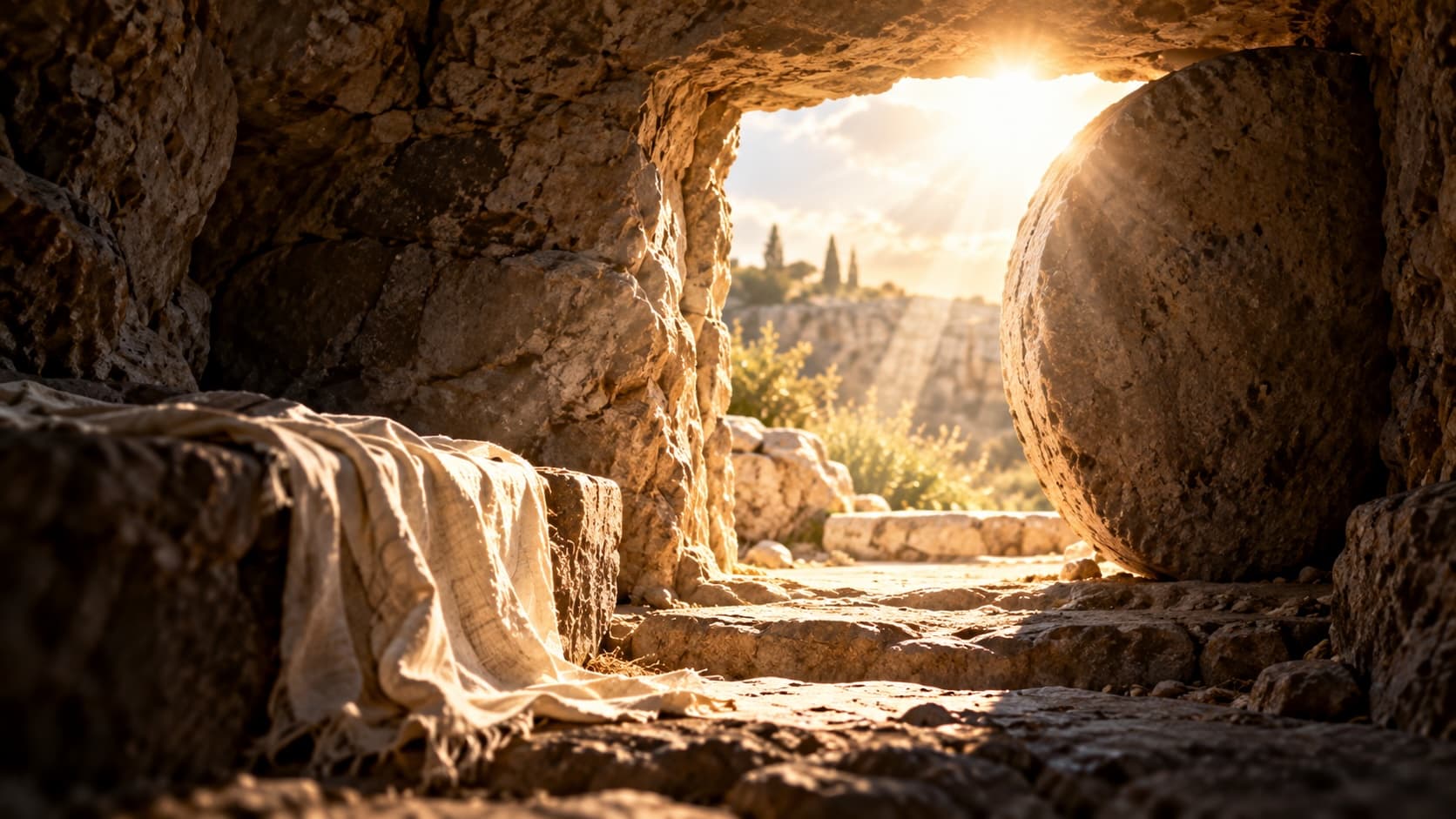
Then Jesus, deeply moved again, came to the tomb. It was a cave and a stone was lying against it.
“Remove the stone,” Jesus said to Martha.
Martha, the dead man’s sister, told him, “Lord, there’s already a stench because he’s been there four days.”
Jesus said to her, “Didn’t I tell you that if you believed, you would see the glory of God?”
So they removed the stone. Then Jesus raised his eyes and said, “Father, I thank you that you heard me. I know that you always hear me, but because of the crowd standing here, I said this so that they may believe you sent me.”
After he said this, he shouted with a loud voice, “Lazarus, come forth.”
The dead man came out, bound hand and foot with linen strips, and with his face wrapped in a cloth.
Jesus said to them, “Unwrap him and let him go.”
May God add his blessing to the reading, the preaching, and your hearing to understand his holy word. May our Lord and Savior Jesus Christ forever be praised.
And all of God’s people say, “Amen.”
Amen. You may be seated.
Every one of us here today have experienced death.
The Bible tells us in Ecclesiastes chapter 3, “For everything there is a season and a time for every activity under heaven, a time to be born and a time to die.”
That truth is woven into the very fabric of human life. We know that just as certainly as we hear a baby’s first cry, we will experience a last breath.
Every family in this room has experienced it, faced it, dealt with it. Every heart here has felt it deeply in the very fibers of our being.
We’ve stood in hospital rooms. We have stood in funeral homes. We have stood at the gravesides and cemeteries. We’ve watched people that we love slip away. We’ve walked through seasons of grief that words can barely describe.
That’s why we can feel the depth of sorrow in this passage.
They’re in the home of Mary and Martha. Their beloved brother Lazarus has died, and their house is filled with mourners. Friends and neighbors gathered with tears flowing freely.
In that culture back then, grieving—grieving was not done quietly or hidden away. Grieving was a whole community affair, and they did it in great big groups. Grieving when someone died was loud. It was public. The people cried together, prayed together, they mourned together in their time of loss.
And because all of you have lost someone, you understand that moment. You understand the weight of that moment. You understand the questions that were going through Mary and Martha’s minds, as everyone else’s mind as well.
Why now?
Why did they die this way?
Why didn’t God intervene?
Mary and Martha had those questions. They had those questions.
Even though—watch this now—even though they knew Jesus. They knew him. They loved Jesus. They believed in Jesus.
And yet Lazarus, their brother, still died.
But the encounter with death in John 11 was different. This funeral would not end the way that all other funerals normally end.
Because on that day, death was about to meet the one who created life.
On that day, a grieving family would hear the words that changed history when the Lord himself says, “I am the resurrection and the life.”
And when Jesus speaks those words, friends, the grave—the grave no longer gets the last word.
If you don’t hear anything else from this sermon today, this is what this sermon says. This is what Jesus and Lazarus and Mary and Martha, this encounter says:
The grave doesn’t get the last word.
And so this morning, we continue in the same pattern that we’ve had in all the sermons. We begin with a retelling of the story. There’s actually more to the story than the verses that I read.
There was a man named Lazarus. He lived in a village called Bethany. He had two sisters, Mary and Martha. And this family had a close relationship with Jesus, closer than most people.
They didn’t just know about Jesus. They knew him personally. He had eaten at their table. He had fellowshipped in their living room.
Well, one day in Bethany, Lazarus became seriously ill. We’re not told what the diagnosis was. We don’t know what it was, but we know that in the ancient world, even a minor infection could quickly become deadly. You could die from a cut on your hand if you got blood poisoning.
Mary and Martha realized the danger.
They sent a message to Jesus. The message was simple: “Lord, the one you love is sick.”
Notice what they didn’t say. They didn’t demand anything.
They simply put the situation in front of Jesus.
And when the message was heard by Jesus, he did—he said something pretty remarkable. He said, “This sickness will not end in death.”
And friends, that’s a phrase all we believers need to take to heart. If they are a believer, if your loved one is a believer, I can give you this promise that the sickness, whatever the sickness may be, will not end in death.
Death may be along that path, but death isn’t the end of the path for the believer.
Amen.
It was going to be for the glory of God, so the Son of God may be glorified through it.
By the time he finally told the disciples that they were returning to Judea, they were concerned. Jesus had a bad experience there in Jerusalem.
“Rabbi,” they said, “the Jews just tried to stone you there, and we’re going back?”
Jesus tells them a kind of parable, a short little parable. He says, “If you walk with the light, you won’t stumble in the darkness.”
Basically, he was telling them, “Just follow me, guys. Just follow me.”
Danger or ease, just follow me.
And then Jesus says something even more puzzling. He says to the disciples, “Our friend Lazarus has fallen asleep, but I’m on my way to wake him up.”
The disciples misunderstood just like you and I would have.
“Lord, if he’s fallen asleep, he’ll get well. He’s resting. And when he rests up real good, he’ll be well after that.”
So Jesus told them plainly, “No, that’s not what I’m saying. I’m telling you Lazarus has died.”
And then Jesus says, “I’m glad that Lazarus has died for your sake. I’m glad that Lazarus has died because you’re about to see something more extraordinary than death. I am glad that he is dead because you are going to have a reason to believe something greater was going to happen.”
Oh, Thomas was there.
Y’all know Thomas?
He’s known as what? Doubting Thomas.
We give Thomas a bad rap a lot of times.
Thomas is there, and he says something courageous this time. Thomas says, “Danger or not, let’s go with him and we’ll die with him. If he dies in Jerusalem, we’ll die with him.”
Thomas believed even though there was danger. He followed even though it was danger.
Then Jesus and the disciples go to Bethlehem.
Let me briefly describe what happens there.
By the time Jesus arrives in Bea—Bethany, Lazarus has been in the tomb four days.
Martha comes out and meets Jesus. She says, “Lord, if you had been here, my brother wouldn’t have had died.”
But then she says—but even in her grief, she says, even in her sorrow, she says—“Yet even now I know that whatever you ask from God, he will give you.”
Then comes that powerful statement, maybe one of the most powerful statements in all the Gospels.
She said, “I know he’ll rise at the resurrection.”
Jesus says, “Dear woman, I am the resurrection. I am the resurrection and the life. The one who believes in me, even though he dies, yet shall he live again.”
Do you understand what this story is about?
Do you understand why Jesus had this encounter?
Martha answers with remarkable faith. She says, “Yes, Lord. I believe you are the Messiah, the Son of God.”
Then soon Mary, the other sister, comes weeping. The mourners are weeping. And when Jesus sees their sorrow, then there’s the shortest verse in the Bible.
How many of you at Bible verse night remember memorizing the shortest Bible verse in the Bible?
All right, it’s your turn for your Bible verse.
John 11:35: “Jesus wept.”
They lead him to the tomb. The stone rolled across the entrance.
Jesus says, “Remove the stone.”
Martha doesn’t want him to.
“Don’t remove the stone. Lord, it’s been four days. This ain’t going to be good.”
But then Jesus prays to the Father and calls out in a loud voice, “Lazarus, come out.”
And the man who had been dead walks out alive.
The next verse says, “And many who witnessed it believed in him.”
And that is the question from this great Bible story:
Do you believe this?
Our truths to remember.
Truth number one: the raising of Lazarus gives us instructions on hope and salvation.
When Martha met Jesus, she was—she was caught between grief and hope. She said, “If you had come here, he would not have died.”
But she also says, “Even now, I know God will answer for you.”
That is the tension in the Christian life. And if you have, as a believer—and we, we grieve differently as Christians and those who don’t know the Lord. We grieve differently as believers than people who don’t have the hope of heaven.
That is the tension that we have.
We grieve.
We see the reality of the suffering.
We know that suffering and death are real, but we know that God is greater.
Jesus declared this revolutionary statement.
He didn’t just promise her the resurrection. He said, “Resurrection isn’t just an event. Resurrection isn’t just something that’s going to happen. Resurrection is a person, and I am he. I am the resurrection.”
Folks, hope—hope is not found in circumstances.
Hope is found in Jesus.
Hope is not found in events and happenings.
Hope is found in a person, and it’s Jesus.
And he asked Martha this question:
“Do you believe this?”
That’s the question for each one of us.
Do you believe this?
Truth number one says, “The raising of Lazarus gives us instructions on hope and salvation.”
Truth number two: the raising of Lazarus shows us Jesus’s identification with human sorrow.
Verse 35 said, “Jesus wept.”
Think about that.
[clears throat]
Jesus knew exactly what he was going to do within mere minutes.
Look at this. Get it. Get into the scene.
Jesus is surrounded by weeping, crying people. Jesus is right in front of two grieving, crying sisters whose brother is dead. He knows within minutes Lazarus is going to come walking out of that tomb.
Yet at that moment Jesus wept.
Why?
Because he saw the sorrow of Mary. He felt the pain of Martha. He saw the brokenness that sin had brought into the world, and with it, death.
Folks, Jesus is not distant from your suffering.
Jesus is not far away when you cry.
He does not overlook your pain.
He cries with you.
He is with you.
“I will never leave you or forsake you.”
It is Psalm 56:8 that I shared with the boys and girls that says God stores all of our tears in a bottle and does not forget a single one.
Psalm 56:8.
You might want to write that down for future reference, to be reminded that every tear matters to him.
When you cry, Jesus cries with you.
When you hurt, Jesus feels your pain.
The Savior who raises the dead is the same Savior who stands beside us when we grieve someone who dies.
Truth number three: the raising of Lazarus illustrates what was happening next, what was happening soon.
This miracle was more than just compassion.
It was a preview.
As I talked about the cave and the tomb and the stone rolled in front of the door, you were reminded of something that we’re going to celebrate in just a few weeks, right?
When Jesus encounters Mary and Martha and when he raises Lazarus, Jesus is soon himself going to enter a tomb.
Soon a stone is going to be rolled in front of the door of his tomb.
Soon the world is going to believe that death won.
But just as Lazarus walked out of that grave, Jesus would walk out of the tomb alive.
And when he did, he would prove once for all that death does not have the final word.
The resurrection of Lazarus pointed forward to the greater resurrection of Jesus Christ.
The resurrection of Lazarus—and folks, I believe it truly happened.
I believe Lazarus was dead. Every cell in his body was dead.
And I believe Jesus reconstituted life in every cell of his body and brought him out alive.
And I believe that Jesus was crucified dead.
I believe there was not one breath of life left in Jesus when he was sealed in that cold, dark tomb.
And I believe that early Sunday morning, up from the grave he arose.
And because Jesus rose from the dead—listen to me, dear saint, dear grieving soul—because Jesus, not because Lazarus did, but because Jesus rose from the dead, everyone who believes in him, everyone who belongs to him, will live forever.
How do we respond in faith to these truths?
Believe the promise.
Believe the promise of Christ.
Jesus asked Martha, “Do you believe this?”
And so I ask each one of you, every person, no matter your age, no matter your station in life, every person here, every person watching on Facebook, I ask you:
Do you believe this?
Amen.
Do you believe this?
It is a question for every one of us.
Children, listen. Your parents cannot answer this question. You’ve got to answer this question, boys and girls.
Do you believe this?
I cannot answer this question for you.
As your pastor, you must answer it yourself.
Do you believe this?
That’s how salvation comes. Salvation comes when we place our faith in the one who conquered the grave.
Believe the promise.
Trust Jesus, number two, even when you don’t understand his timing.
Mary and Martha both wondered why Jesus waited, but he had a purpose.
Sometimes God’s timing, sometimes God’s plan, doesn’t make sense to us.
But folks, even if we don’t understand the plan, even if we don’t understand the timing, even if we don’t understand the why, we can trust the one who’s seen the whole picture.
Lastly, come to the one who calls the dead to life.
Come to the one who calls the dead to life.
Because here’s the Bible truth, friends.
Ephesians chapter 2 tells us that when we were dead in our trespasses and sins—not when we were bad and needed to be better. No.
When we were dead in our trespasses and sins.
Not when we weren’t religious enough and needed to memorize the Ten Commandments. No.
When we were dead in our trespasses and sins, God, who is rich in mercy, with his great love wherewith he hath loved us, made us alive in Christ.
For it is by grace you have been saved through faith, not of works, lest any man should boast.
If you’ve never been born again, if you’ve never been saved, you are dead.
You are as dead as Lazarus in the tomb.
Your heart may be beating.
Your lungs may be breathing.
Your mind may be thinking.
But if you’ve never been born again, you are spiritually dead.
You don’t need to do better.
You don’t need to be better.
You don’t need more religion.
You need Jesus to make you alive.
And just like Lazarus, we were just like him: dead.
Jesus called his name, and he came out alive.
And I wonder today whose name here Jesus may be calling.
He’s calling your name to come out of that tomb of the sin death into the light of eternal life.
Come to Jesus.
Let us pray.
Heavenly Father, I pray that this morning people have heard these great truths. Truths that span generations and time and economies and borders. Truths that are for every man, woman, boy, and girl.
I pray they’ve heard them.
Now, Lord, I pray that they will have the faith to obey these truths, to come to you in faith this morning.
For the one that needs to come and bow at this altar, let them come.
For the one that needs to come forward this morning professing faith in Jesus and coming asking for believer’s baptism, let them come this morning.
Whatever the decision needs to be, let it be made for God’s glory and the good of God’s people.
We pray in Jesus’ name.
Amen.